Showing posts with label may2019. Show all posts
Monday, June 3, 2019
Graceling by Kristin Cashore
Graceling by Kristin Cashore has been sitting on my shelf for a long time - like, for several years. It's been so long that I don't even remember where I bought it, or what attracted it to me in the first place. I used to love young adult fantasy when I was...well...a young adult, I guess, but I've lost some of my zest for it in recent years. Thanks to book reviews on Youtube, however, I'm slowly making my way back to the genre. After hearing a few reviewers talk about this one, I decided to give it a go and finally check it off my TBR.
Graceling takes place in a realm known as the Seven Kingdoms. In this land, a small segment of the population is born with a "grace," or a special talent. The graces people can be born with take many forms, from mundane activities like being really excellent at swimming, to supernatural skills like the ability to read minds. Those born with a grace are regarded with suspicion by the rest of the ordinary citizens of the kingdom, so to be a Graceling is a mixed blessing at best.
The plot of the novel follows King Randa of the Middluns' niece, a young woman named Katsa. Katsa was born with a killing grace - she is able to defeat anyone in combat with ease. As this sort of skill is quite useful for a monarch, the king uses her like his own personal weapon. He sends her out to do his dirty work, killing, beating, and torturing his enemies. Inwardly, Katsa hates using her grace for this purpose, but she feels like she has no choice but to comply. To make up for some of her actions, she works secretly with a network of sympathizers to help out people in need all across the land.
As part of this secret work, Katsa rescues a man who has been kidnapped and hidden in a neighboring kingdom. It's a mysterious case; Katsa can't determine who gave the original order to kidnap the man or uncover any motives as to why. In her investigation, she ends up working together with the kidnapped man's grandson, Po, to try and uncover the truth of what happened. Their investigation ends up leading them into a dangerous adventure full of danger, conspiracy, and, of course, romance.
I was surprised at how much I ended up enjoying this novel. The plot is full of interesting ideas, the characters are likable and well-developed, and the pacing is excellent. The idea of the graces is unique and adds variety and suspense to the story, along with some good opportunities for character growth. There were no points where I was bored or felt like reading was a slog. Even the romance, which can easily be cringe-worthy in young adult fantasy, was believable and sweet to read. While this doesn't rise to the ranks of giants in this genre, like Harry Potter, it is highly entertaining and worth the time.
Katsa is an admirable heroine for young readers to look up to. The days of damsels in distress are long gone in young adult fantasies these days, but I found Katsa to be different than the new sort of "tough-girl" characters we see now. While she is undoubtedly independent and able to take care of herself, her feelings about those abilities are complex. Her skills are a result of her grace, and she is constantly using it in a way she is uncomfortable with for the king. Beyond that, she finds it difficult to control it, with anger often driving her to impulsive and dangerous actions. Part of her story is learning to take ownership of her grace and to use it in ways that she sees fit. She changes quite a bit from the beginning of the novel, and that growth arc is satisfying to read. Her feelings and emotions feel genuine, even if her abilities are impossible. It makes it easy to suspend your disbelief and go along for the ride.
There are two companion novels in this universe, which I an interested in reading soon. Kristin Cashore has created an interesting world in Graceling, and I want to spend more time there. If I had actually read this book as young adult, I feel like it would have ended up being a favorite of mine. Reading it now, I am still impressed and entertained. It's simply a great story, and you can't ask much more than that from this sort of novel.
Challenge Tally
Finally in 2019: 16/6 Books Read - Complete!
Total Books Read in 2019: 31
Monday, May 27, 2019
Jude the Obscure by Thomas Hardy
Back when I was in college, I took a literature course called "Realism and Naturalism." I didn't know anything about this literary period when I first went into the class, but it was my favorite one by the time I came out of it. Something about the stories I read here fascinated me. They were gritty and dark and pretty much always ended with a tragedy, but still, I was in love. For the first time, I found myself having actual thoughts and opinions about literature. I started raising my hand and speaking with classmates. I started reading classic novels with the same kind of interest that I had for contemporary novels. Best of all, this was the class where I met some of my favorite authors. Edith Wharton, Frank Norris, and Henry James became authors that I still seek out and read to this day.
The instructor for this course was a young graduate student, but her enthusiasm for this period and her expertise were clear. I loved the reading selections she made and the way she taught the course. I distinctly remember her telling us one day that her favorite naturalism novel of all time was Jude the Obscure. This wasn't one of the readings assigned in the class, but I always remembered the title, and meant to read it myself one day. When I saw that one of the categories in the Back to the Classics challenge was a "classic tragedy," I figured that this was the perfect time to pick it up.
The plot of the novel follows Jude Fawley, a young orphan being raised by his aunt in a small English village. Despite being born into a poor family, Jude has scholarly aspirations. He dreams of attending one of the colleges in Christminster, a nearby, academically-focused city. He embarks on a course of self-study, teaching himself Latin and Greek and reading everything he can get his hands on as he grows into maturity. In an effort to fund his reading materials and eventual tuition payments, Jude apprentices himself to a stone mason, and he eventually becomes quite skilled at that trade. As he works and trains, however, he always holds fast to his dreams of higher education and uses all his free time to continue his personal studies.
Things begin to veer off track for him when he meets Arabella Donn, a country girl living near his aunt's house. He begins a relationship with her that becomes physical very quickly. A pregnancy scare leads him to push his studies aside and get married, a step he almost immediately comes to regret. His marriage with Arabella is a very unhappy one. They quarrel constantly and are obviously unsuited for each other. After a particularly bad fight, Arabella decides to move with her family to Australia, and Jude is only too happy to let her go. He returns to his studies again, but with a shadow over his heart. By entering into a marriage, he knows that he has spoiled any future romantic prospects in his life. His wife may be out of the country, but she is still his wife, and he is living in a time where the social attitudes concerning marriage and divorce are extremely conservative. Marriage is forever here, so Jude has doomed himself.
He still has his academic dreams though, and he resolves to continue forward on that path. He redoubles his efforts in that direction and finally moves himself to Christminster, the city he has been in love with since his childhood. He is soon thrown off track again, however, for two reasons. One, he discovers that the cost of attending a university is so expensive that he will realistically never be able to afford the tuition no matter how hard he works, and two, he meets his cousin, Sue Bridehead, and falls hopelessly in love with her. Both of these events are disastrous for Jude. Realizing that his scholarly goals will never happen ruins a huge part of his identity, and his love for Sue is tragically impossible. He is already married, and she is about to be married to someone else herself. Sue has strong romantic feelings for Jude too, but she goes through with her own wedding anyway, and winds up desperately unhappy.
Despite that fact that everything about a relationship between Jude and Sue is inappropriate at this point, the pair can't keep away from each other. Through a combination of moving between different towns and making arrangements with their original spouses, they manage to get divorces and move in together. However, neither wants to get married again, even to each other, based on the bad experiences they had the first time around. Instead, they live together and have children out of wedlock, an act that alienates them from society and creates huge financial difficulties for them. Things go from bad to worse for the pair until a truly shocking act drives them towards their final ruin.
I don't use the word "shocking" here lightly. The end of Jude the Obscure is horrific and tragic and I did not see it coming. If any readers out there aren't already spoiled as to the specifics of it, I strongly encourage you to read the book for yourself and let it hit you. It feels like a punch in the chest. It will be a reading moment you always remember, which is something I love about novels from this time period.
I don't mean to imply, however, that the final events in the novel are just a gimmick or there merely for shock value.Thomas Hardy's themes are clear throughout the text. His message is all about how harmful social divisions and expectations can be, especially the attitudes and laws around marriages in the late 1800s. We see this in Jude's failed academic pursuits and in the string of failed marriages taking place across the novel. In Jude, we have a character that is doing the best he can. He saves money and studies to achieve academic success, he marries a woman when he believes it is the only honorable course of action, he lets that woman go when it becomes clear they are both unhappy, and he tries to be a good provider for the woman he discovers later on to be his one true love. None of that is good enough.
The problem is, Jude wasn't born at the right social station to do anything more than be a tradesman and follow the rules. He reaches too high and gets smacked right back down. Hardy's story allows that reader to see that Jude didn't deserve this, and that the rules governing society at this time period are unnecessarily punitive. Why is it so improper and ridiculous for a man to want to improve himself? Why is the barrier to entering a university so high? Why can't people obtain divorces easily and without intense social stigma? Why is a marriage necessary for domestic happiness at all?
These kinds of questions brought Hardy some negative reviews when Jude was first published. People interpreted his work as being anti-marriage and labeled the novel as "obscene." Hardy wrote about these reactions in the postscript to the first edition of the work, in which he defended himself as being not anti-marriage, but pro-divorce. His opinion was that, "a marriage should be dissolvable as soon as it becomes a cruelty to either of the parties," a view that seems quite reasonable now, but was very controversial during his lifetime. He ended up being so disappointed with the reception to this novel that he never wrote another one. Jude the Obscure is his very last book, which is a shame, because he lived another 33 years after it's publication.
Along with from the complex themes present in the novel, there are many other aspects to enjoy. Hardy's prose is masterful, his characters are layered and nuanced, and his plot twists and turns are very engaging. This is one of those classics that is on the longer side, but still easy and relatively quick to read. The only thing difficult about it is how dark it is. Nothing goes right for Jude, and that gets to be heavy after a while. However, if you enjoy sad novels, you can't do much better than this one.
Thinking back to my college instructor who called Jude the Obscure her favorite book, I can understand why she liked it. This is a well-written work that asks interesting social questions and gives readers a wonderfully tragic story to hang those questions around. This novel didn't grab me in the same way the other works we read in the class did, so I would still say I prefer Edith Wharton or Frank Norris overall, but this was still a very worthwhile read and an excellent choice for my "classic tragedy" challenge category.
Challenge Tally
Classics Club (#33 on my list): 46/100
Back to the Classics 2019 (Classic Tragedy) 7/12 Books Read
Total Books Read in 2019: 30
Sunday, May 12, 2019
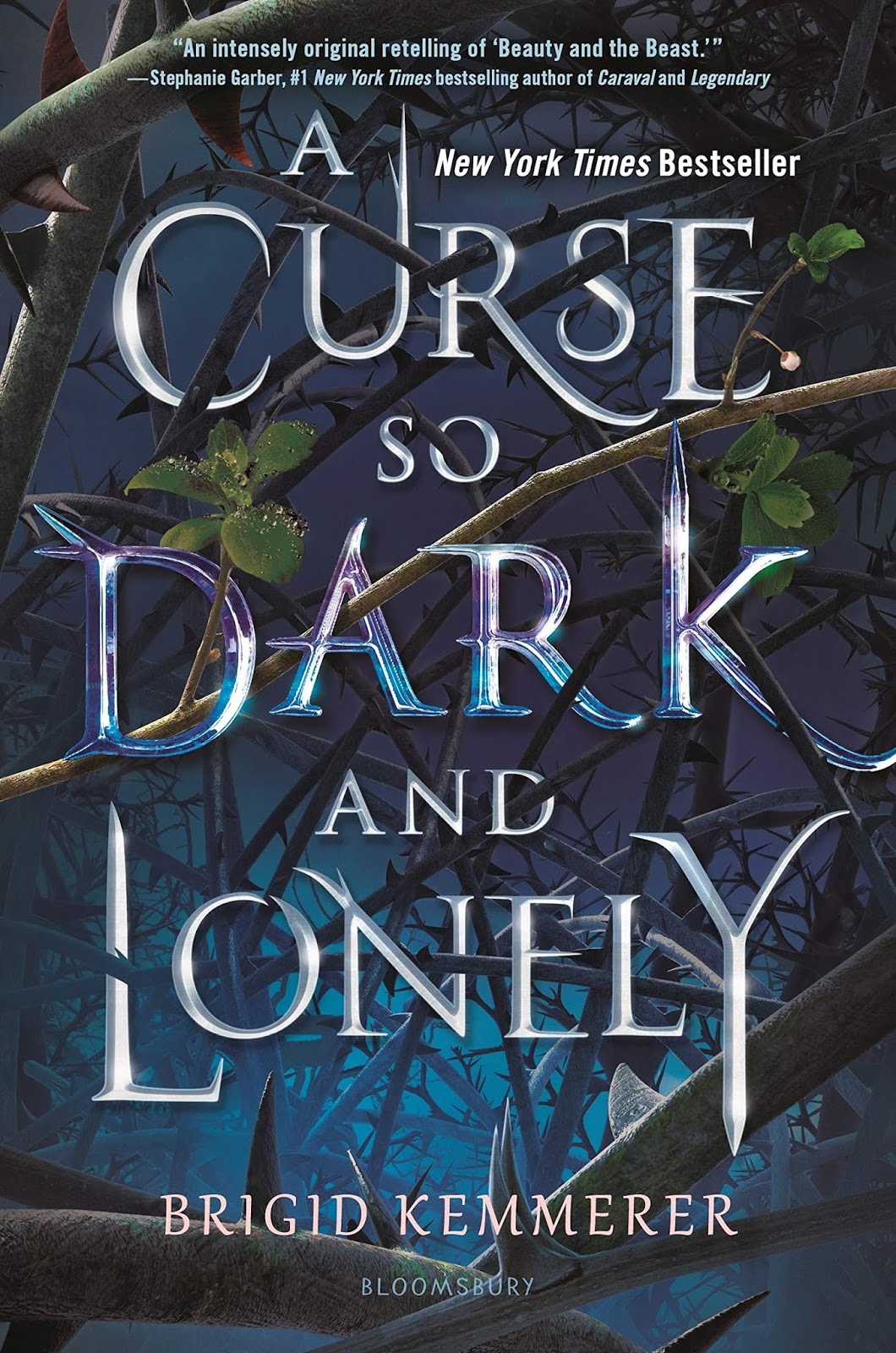
A Curse So Dark and Lonely by Brigid Kemmerer
For my next read, I was in the mood for some young adult fantasy. I picked up A Curse so Dark and Lonely from Target last month, so I decided to give that one a shot. It's a "Beauty and The Beast" reimagining, and I have a weird fondness for stories inspired by fairy tales, so I went into my reading with pretty high hopes. I was expecting romance, adventure, and maybe, hopefully, a scene in which a young woman is gifted an entire library (which is not something from the original tale, I know, but it is my favorite part of the movie).
A Curse So Dark and Lonely is told from two alternating perspectives. The first perspective is from Rhen, the prince of a kingdom named Emberfall. Rhen has been cursed by an evil enchantress to keep repeating the same three months on an endless loop in his castle. At the end of each of these three months, he transforms into a monster and goes on a rampage around Emberfall, killing anyone in sight. At the end of his rampage, the season resets and he becomes himself again. The villages outside his castle don't loop with him, they still experience the forward march of time, and any people killed there stay dead. It's only Rhen, his only remaining guardsman, Grey, and his castle that reset. In order to break this cycle ad sync back up with the rest of his kingdom, Rhen must find a girl to fall in love with him. He's wooed countless girls over countless cycles of his curse, but he hasn't had any luck finding true love yet.
The second perspective in the novel is from Harper, a young woman living in our modern reality in Washington D.C. As the story begins, she is mysteriously whisked away into Rhen's timeline, where he plans to try his luck wooing her in order to break his curse. Harper, however, is completely unlike the other women he has tried this with in the past. She is a fighter and isn't willing to entertain any ideas of romance. She only wants to find a way home, back to her struggling family and terminally ill mother. She will stop at nothing to return, and even attempts to confront the enchantress responsible for the magic that brought her to Emberfall. The longer she stays in the kingdom, however, the more she comes to care about the people living there, including Rhen and Grey. A rival kingdom has noticed the absence of the royal family and a lack of soldiers protecting Emberfall, and is making moves to invade the territory. Her desire to help the struggling kingdom directly conflicts with her need to return home. As the danger to Emberfalls grows, Harper must try to find a way to help all of the people she cares about.
I ended up liking this novel a lot more than I thought I would. Kemmerer's take on a classic fairy tale is creative and interesting, and her characters were well-developed. I especially enjoyed Harper; she was far from a damsel in distress, and was eager to learn how to fight and take care of herself when given the opportunities. I also liked that fact that she was very principled. Even when thrown into an entirely different world, she did not hesitate to defend people who needed it and stand up for what was right. She comes to care deeply about the people of Emberfall, which helps forge a powerful connection between her and Rhen. It was obvious from the beginning that these two characters were destined to fall in love, but I appreciated that the eventual relationship was forged through the strength of her character rather than through superficial characteristics, like her beauty.
It's also noteworthy that Harper has cerebral palsy, which is a congenital disorder than affects movement and coordination. The condition affects people in different ways; in Harper's case, she has a pronounced limp and weakness in one of her legs. She does not let this illness define her, however, and manages to make her way around the world just fine. Kemmerer portrays her well in this regard. She is a character with this disorder, but it does not define her. It is mentioned from time to time, but is not treated as a big plot point. It's just a part of who she is, which is true for the hundreds of thousand of people who have it in real life. You don't often see protagonists with medical conditions like this where the condition is not the whole focus of the story. I appreciated this. We need more characters like this in our young adult books.
Rhen and Grey were also characterized well. Rhen was suitably tormented by the curse, and his feelings of guilt and despair at the situation were interesting to delve into. Unlike in the original fairy tale, Rhen is initially cursed because he spent the night with the evil enchantress, promised her the world, then didn't deliver. Of course, he was spoiled and selfish in his youth as well, but having the enchantress be a spurned lover was an interesting twist on the story. It made the curse more personal, and allowed the enchantress character to have a bit more depth. She appears throughout the story, and her cruel, twisted behavior helps the reader sympathize more with Rhen. He definitely learns and grows throughout the cycles of his curse, seeing him be forced to watch his kingdom suffer because of his selfishness while he is stuck in time makes this change feel genuine.
I admit though, that I was more of a fan of Grey, the lone, faithful guardsman to Rhen. He stays by his prince, helping him try to break the curse, long after all of the other Emberfall guardsmen have fled or been killed. I have a thing for loyalty in characters, so his perseverance to his job and his unfailing friendship with Rhen really appealed to me. I was secretly hoping that he'd end up with Harper, as there was definitely a bit of a spark between them too, but of course, his type of character wouldn't do such a thing to Rhen.
While the book was engaging throughout, I did think that things moved too slowly in the middle. There were several scenes in an inn where Harper and Rhen assisted some villagers that I could have done without, as well as some sections where they visited neighboring villages that dragged. The novel is almost 500 pages long, and some trimming definitely could have been done here and there. Also, the story eventually becomes intensely political, with strategy sessions and battle plans taking center stage. I would have preferred more scenes developing the romance between the protagonists instead. However, the ending of the book is exciting and interesting enough to make up for the slow parts and I still consistently enjoyed my read.
The novel ends with an epilogue that contains a major cliffhanger, meaning that I'm going to be anxiously awaiting the sequel that is set to come out in 2020. I will definitely continue on with the series, despite the fact that Harper was (sadly) not bookish at all and there was no library scene. This was a very creative and different take on a classic fairy tale and I am looking forward to diving back into the world of Emberfall next year.
Challenge Tally
Finally in 2019: 15/6 Books Read - Complete!
Total Books Read in 2019: 29
Subscribe to:
Posts (Atom)