About Favorites Classics Club Past Years Past Challenges
Showing posts with label march2017. Show all posts

Saturday, April 1, 2017

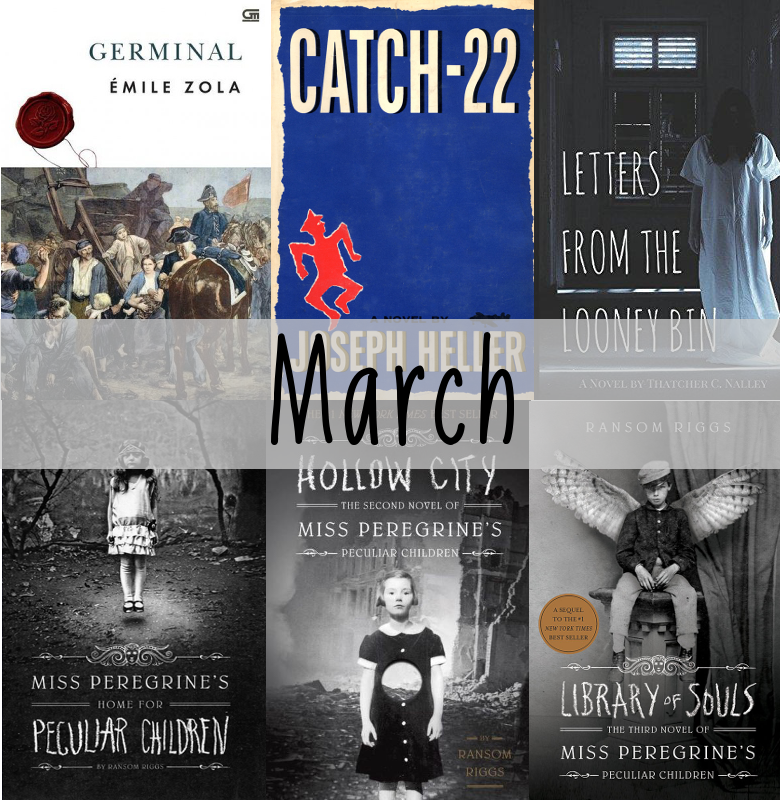
March 2017 Reading Wrap Up


Image from whytoread.com

This month wasn't quite as successful as February was for me, but I did finish reading everything I had planned. Here's the final breakdown: 

1. Germinal by Émile Zola (4/5 stars)

  • Back to the Classics: A classic in translation
  • Classics Club: #32 on my list
  • Popsugar Challenge: A book by an author from a country you have never visited
  • Mount TBR: previously owned
2. Catch-22 by Joseph Heller (3/5 stars)
  • Back to the Classics: A classic with a number in the title
  • Classics Club: #6 on my list
  • Popsugar Challenge: A novel set during wartime 
  • Mount TBR: previously owned
3. Letters from the Looney Bin by Thatcher C. Nalley (1/5 stars)
  • Popsugar Challenge: A book of letters
  • Mount TBR: previously owned
4. Miss Peregrine's Home for Peculiar Children by Ransom Riggs (4/5 stars)
  • Popsugar Challenge: The first book in a series you haven't read before
  • Mount TBR: previously owned
5. Hollow City by Ransom Riggs (3/5 stars)
  • Popsugar Challenge: A book with pictures
  • Mount TBR: previously owned
6. Library of Souls by Ransom Riggs (2/5 stars)
  • Mount TBR: previously owned 

I read two very memorable classics this month - the socially conscious Germinal and the post-modern classic Catch 22, both of which I enjoyed. I was also pleasantly surprised by how much I liked the first book in the Miss Peregrine series. I really like the world that Ransom Riggs created in those novels and I'm glad my challenges pushed me to finally read them.

My least favorite read of the month was the disastrous Letters from the Looney Bin, an independently published novel that ended up being very sloppy. Unless I stumble across something truly awful, this will most likely be my worst read of the year. At least I got it out of the way early!

My current challenge status is:


Heading into April, the plan is to keep pushing forward on my challenges, especially my Popsugar challenge. I want to finish the original 40 categories as soon as possible so I can unlock the bonus categories. One of them is to read a book that is more than 800 pages. I'm reading War and Peace for my Back to the Classics challenge this year, and I need that category to be available once I pick it up later on.

Library of Souls by Ransom Riggs


*This review contains spoilers for Hollow City, the second book in the Peregrine Series*

I finished up my reading for the month of March with the third and final book in Ransom Riggs' Miss Peregrine series, Library of Souls. This novel picks up immediately after the events of the second book, with Jacob, Emma, and Addison (the dog) facing off against a Hollow in a London train station. The scene is chaotic - they are still reeling from the revelation that the bird they assumed was Miss Peregrine in book two was actually her evil brother Caul, they have just been separated from the rest of their group by a veritable army of wights, and Jacob has discovered that he is able to speak to hollows. After using his newfound ability to force the monster to stand down, the group manages to slip onto a train and escape. From that point on, they embark on a dangerous journey to find the real Miss Peregrine, rescue their friends, and put an end to Caul's disastrous plans for world domination.

Much like Hollow City, this novel takes place over the course of a couple of days. Most of the action is centered in a loop called Devil's Acre, a slum in Victorian England where Caul has set up his headquarters. The setting is suitably ghoulish, with creepy and unscrupulous characters lurking around every corner. Also living in Devil's Acre is the enigmatic Myron Bentham, a man who has spent his life building a machine to allow Peculiars to travel between loops with ease. He both helps and hurts Emma and Jacob throughout the novel, making it difficult for the reader to determine where his loyalties lie. As many of the characters we know from the previous books do not appear in most of the novel, Myron, and a few other new characters, play a large role in the action.

While Library of Souls provided a definitive ending to the series, it ended up being the weakest of the three novels for me. There were long stretches were I was bored and had to force myself to keep reading just to get through it and see how everything ended. The story wasn't exactly bad, but it didn't have my on the edge of my seat either. I was not as engaged in the action as I was with the previous books, and I felt like Riggs was playing a bit fast and loose with the rules of his universe to accommodate an increasingly weird and complex storyline. This book was over 400 pages long and it felt like it.

Riggs' decision to isolate Jacob and Emma throughout most of the novel was an unfortunate one. The other Peculiar children don't appear until page 300 or so, and I keenly felt their absence. As I mentioned in my previous review, I'm not a fan of  Jacob and Emma's romance. Eliminating all of the other characters for most of the book meant that their relationship really took center stage in this novel, and I didn't enjoy that. After getting to know all of the other children more in Hollow City, I felt robbed of getting a chance to see them shine again here. Riggs' cast of supporting characters has always been more interesting than Jacob and Emma. Cutting them out of most of the last book felt wrong.

Despite the fact that I had some issues with Library of Lost Souls, it wasn't a complete disappointment. The ending was a bit odd, and at times it was stretching my suspension of disbelief, but it did provide a satisfying conclusion to the series. The parts of the adventure that were exciting were good enough to get me through the more boring parts. While I wish that this novel had all the mystery and wonder of the first book in the series, I'm not sorry that I saw the story of Miss Peregrine and her children through to the end. This is a solid little young adult series that I know I'll be recommending to my students.


Challenge Tally
Mount TBR: (previously owned) 19/60


Sunday, March 26, 2017

Hollow City by Ransom Riggs


*This review will contain spoilers for Miss Peregrine's Home for Peculiar Children (Book 1)*


After being thoroughly impressed by Miss Peregrine's Home for Peculiar Children, I picked up Hollow City, the second book in the series, excited to see the story of Jacob and his Peculiar friends continue. The novel picks up right where the first story left off, with the children setting off from their demolished home to try and rescue Miss Peregrine, who is trapped in her bird form. They have only the vaguest of clues about where to head next and little chance of actually succeeding in their quest, but their love for their protector and friend drives them onward.

The little bit of information they do have leads them to London, where they hope to connect with another ymbryne (a Peculiar word for a woman who can transform into a bird and alter the flow of time) to help Miss Peregrine change back into her human form. However, their journey is plagued with difficulties since wights and hollows are on their trail and waiting to capture them at every turn for their own mysterious schemes. Jacob and his friends must race against time to evade the monsters chasing them and find Miss Peregrine the help she so desperately needs.

My feelings on this novel are not quite as positive as my feelings on the first in the series, but I did still enjoy it very much. This was the middle book in a series, and it felt like a middle book, with parts that dragged and a plot that meandered from time to time. Nearly the entire plot takes place over the course of about three days, as the children race from place to place trying to find other time loops, hunt down ymbrynes, and avoid hollows. It was a lot of running around, and it did start to feel repetitive. However, in between all the moments of running were encounters with the wonderfully odd characters that the series is known for. These moments of eccentricity were enough to carry me through the story and keep me engaged. I especially enjoyed visiting the Menagerie, a loop populated by Peculiar animals, including Addison, a talking dog who smokes a pipe, and Deirdre the emu-raffe (a creature who appears to be part donkey, part giraffe).

Another aspect of Hollow City that I enjoyed was the increased character development. More time is spent with the supporting characters in this novel as the children journey to London, and I liked getting to know the other Peculiars better. I became quite fond of Hugh, a boy who can control bees, as he had several heroic moments in the story. I also enjoyed seeing Bronwyn, a girl with incredible physical strength, show her noble and caring side.

Less interesting was the development of Jacob and Emma's relationship, which Riggs spends an unfortunate amount of pages on. I find their romance a bit off-putting because Emma dated Jacob's grandfather before he left their loop. Now she's moved onto the grandson. The fact that Jacob is falling in love with the girl that his grandfather was in love with years before doesn't seem to bother him much, but it bothers me. I'm not a fan of their romance, but it is a central part of the narrative, unfortunately.

Much like the first novel in the series, Hollow City is full of vintage photographs that illustrate the characters and events of the story. I mentioned in my review of book one that sometimes these photos seemed to be inserted a bit awkwardly, and that trend continues here. At times, it felt like Riggs was forcing some of the photos to make sense with the plot. However, the pictures were interesting to look at, and definitely added more to the story than any unnatural writing subtracted, so I did enjoy them.

Hollow City is a novel filled with adventure, danger, time travel, and suspense. I didn't find it quite as engaging as the first novel in the series, but it does a solid job of advancing the story and contains a lot of wonderfully weird moments and plot twists. I'm excited to read the final book and see how everything wraps up. Ransom Riggs has created a unique world with these stories, and I'm loving getting lost in it. 


Challenge Tally
Popsugar Challenge: (a book with pictures) 23/40
Mount TBR: (previously owned) 18/60


Wednesday, March 22, 2017

Miss Peregrine's Home for Peculiar Children by Ransom Riggs


Miss Peregrine's Home for Peculiar Children is one of those series that I'd been wanting to read for quite a while now. I owned all three books and meant to try and get to them before the movie adaptation was released, but I never found the time. The movie ended up being a flop, I got busy with other books I wanted to read, and this series faded into the background for me. With one of my Popsugar challenge categories being to "read the first book in a series you haven't read before," I figured that now was the time to pick this one up.

The story begins with a sixteen-year-old kid named Jacob reaching a turning point in his life. He discovers the body of his much-loved grandfather in the woods as he is dying from a brutal attack. His grandfather's mysterious last words launch him on a quest that brings him to a very curious island in search of any information that could help explain what happened. What he finds there are a group of "peculiar" children, and their enigmatic leader Miss Peregrine. These children, and Miss Peregrine herself, all posses supernatural powers. Invisibility, super strength, and the ability to create and control fire number among their many talents. They have an old connection to Jacob's grandfather, and as Jacob investigates their relationship, he finds himself becoming inextricably involved in their unusual and idyllic world as well. However, everything on the island is not as it seems, and when the group is threatened by a dangerous enemy he must act to honor his grandfather and try to protect his new friends.

This novel was actually much better than I was expecting. It's packed with fantasy elements, including monsters, superhuman powers, and time travel. There's more than enough to keep a fantasy fan engaged. In addition to that, the story is complex and suspenseful. There's more to Peculiar Children than meets the eye. It's not just about a bunch of kids with powers. It deals with questions about family relationships, bravery, and self-discovery. In between all the magic and wonder, there were some rather serious and sad moments. I was pleasantly surprised by how much I enjoyed this one.

One of the unique features of the novel was the inclusion of several vintage photographs. The photos are explained as having belonged to Jacob's grandfather and Miss Peregrine, and they are woven into the story as being images of the Peculiar children. Each time Jacob would come across a photo, it would be printed on the next page for the reader to actually see. The pictures help establish a creepy tone and add visual interest to the story. While their inclusion sometimes felt a bit forced, I think the overall effect was worth any bits of awkwardness in the writing.

Aside from a handful of moments that dragged, I really liked reading Peculiar Children. It was a solid story that was deep enough to be of interest to younger and older readers alike. This novel is part of a trilogy, and I am working on the second book now. I've been told that the series drops off after book one, but I'm hoping that I don't end up feeling that way. In any case, Miss Peregrine's Home for Peculiar Children was a little hidden gem for me. It was sitting on my bookshelf for years, and I didn't really expect much from it, but it ended up being a great read.


Challenge Tally
Popsugar Challenge: (the first book in a series you haven't read before) 22/40
Mount TBR: (previously owned) 17/60


Friday, March 17, 2017

Letters From The Looney Bin by Thatcher C. Nalley


Letters From The Looney Bin ended up in my Amazon shopping cart as part of a big purchase of books for my classroom library. I hadn't heard of it before, but I ended up selecting it anyway since it was labeled an "Amazon Bestseller" and was recommended alongside other popular young adult suspense books that I did know about. Figuring that this story about a creepy asylum was something my students would like, I bought it along with the rest.

When it arrived, I was surprised to see that it looked...different than I expected. The font inside looked weird and the title pages didn't look the same as in other books. A little investigation soon revealed that this was a self-published work from an independent author. I don't usually seek out works like this, but I wasn't really bothered by it because I remembered that this was listed as an "Amazon Bestseller." I thought maybe I had an undiscovered gem in my hands.

I like to pre-read the novels I bring to my classroom, so I stuck this on my shelf with the intent of reading it in the near-future. That was about two years ago. I know...I'm horrible. Anyway, when I saw that one of the Popsugar challenge categories this year was to read a book of letters, I remembered this odd little story, dusted it off, and dove it.

Letters From The Looney Bin tells the story of the Emerson Rose Asylum, a mental hospital that was mysteriously abandoned by all of the doctors and patients inside of it in the late 1970s. Despite investigations, the disappearances remained a mystery. No one from the facility was ever seen again. Years later, the building was set to be demolished. During the demolition process, a packet of letters was discovered stuffed inside of a mattress. The letters, all addressed to the pseudonym "Dr. Quill" were written by the patients inside Emerson Rose. The letters describe the backstories of the patients and the terrible events going on inside the asylum. Through these letters, the reader gets a deeper look at what was behind the mysterious events from years ago.

This novel had a very intriguing premise, and some moments within it were clever, but the execution was an absolute mess. I honestly feel guilty for criticizing an independent author trying to make it in the tough world of literature, but this book had numerous issues and badly needed an editor.

One major issue was a lack of proofreading. This book was full of typos, missing words, words used incorrectly/awkwardly, and paragraph layout errors. Once, a random hashtag appeared at the end of a paragraph. More than once, random numbers would appear between paragraph breaks. Such a large amount of basic mistakes was very distracting and made the novel feel like a fanfiction or a teenager's school assignment. I honestly thought that this novel was written by a seventeen or eighteen-year-old. After a bit of research, I discovered that Thatcher C. Nalley was born in 1969. Yikes.

Another issue was the voice of each character. Each of the letters in the novel was written by a different patient in the asylum, but they didn't sound all that different from each other. Nalley alternated between three personas - her "upper class" voice (which contained a lot of misused words in an attempt to sound smart), her "super crazy-person" voice, and her "normal person describing horrible things in an abnormally calm way" voice. The letters basically alternated between these, so most of the patients didn't really feel like distinct people. The one exception to this was her lone African American character, for which she appeared to be channeling Michael Clarke Duncan from The Green Mile. It was actually pretty offensive.

Nalley's depiction of mental illness was similarly troubling. Nearly all of her characters describe enduring either a physically or sexually abusive past (sometimes it's both). While I don't doubt that childhood abuse can be a major factor in a person's mental health, it felt incorrect for so many of the patients to have their issues stemming from the same source. Not all mental illness is borne from abuse. Similarly, not all victims of abuse go on to lose their minds. I suppose all of the dramatic backstories were an attempt to make the story seem more tragic or shocking, but it honestly got old after so many letters describing pedophile uncles, fathers, priests, etc. What's worse, all of these references make the book an inappropriate choice to bring to my classroom.

The above issues would have been somewhat mitigated by a great, engaging story. However, that aspect of the novel didn't really come together either. The letters spend more time on backstories than they do on the mystery of the asylum, which is what the book was supposed to be about. There are references to an evil doctor performing experiments on the patients and a planned patient revolt, but no real details are given to flesh out either subject. A novel like this should have fed the reader enough specifics across several letters for them to be able to piece together a more complete picture of the situation in their own minds. However, that doesn't happen here. The same few things are repeated across several letters, and the reader never gets a detailed view of what's going on. Furthermore, that story chops off abruptly before the disappearance even happens. This is to accommodate a sequel, but the way it is handled doesn't feel like an expertly crafted cliffhanger. It feels clumsy and unfinished.

Overall, what seemed to be lacking in Letters From The Looney Bin was refinement. Nalley had a great concept, but clumsy storytelling and poor editing ruined what could have been a very creepy and mysterious novel. Still, there were flashes of greatness from time to time throughout the pages. I think there's probably a really cool book in here somewhere. Unfortunately, this one was too sloppy for me.

Challenge Tally
Popsugar Challenge: (a book of letters) 21/40
Mount TBR: (previously owned) 16/60


Thursday, March 16, 2017

Catch 22 by Joseph Heller


“It was miraculous. It was almost no trick at all, he saw, to turn vice into virtue and slander into truth, impotence into abstinence, arrogance into humility, plunder into philanthropy, thievery into honor, blasphemy into wisdom, brutality into patriotism, and sadism into justice. Anybody could do it; it required no brains at all. It merely required no character.” 

My Back to the Classics Challenge required a classic novel with a number in the title, and my Popsugar Challenge asked for a novel set during wartime. It seems like it was my destiny to land on Catch 22 under those circumstances. I was supposed to read this book in 12th grade, but somehow managed to avoid it. I've wanted to go back and give it another shot ever since. However, modern classics have never been my cup of tea. I'm not a fan of unconventional story structure and deliberate confusion, so I wasn't sure how I was going to feel about Heller's famously weird novel. I do want to learn more about this period in literature though (there's a whole section for it in my Classics Club Challenge), so I spent a good part of my spring break this year reading it.

The plot of the novel concerns Captain John Yossarian, a member of the U.S Army Air Force during WWII. He is stationed on Pianosa, a small island off the Italian coast. After flying in several dangerous missions, he develops a healthy fear of dying and becomes determined to get himself out of combat in order to save his own life. Many of his fellow officers are on the same mission, and the story follows several of them in their absurd attempts to avoid conflict. The tone of the story is completely irreverent and often quite funny. Heller takes multiple jabs at the disorganization, greed, selfishness, and bureaucratic nonsense that pervades the army, and makes his characters navigate utterly nonsensical situations in their quests to get themselves sent home. Thrown in with the moments of hilarity are moments that become shockingly serious and graphic. Many of the characters die in the horrific and tragic ways that people do in wars, and this contrast between the funny moments and the somber ones serves to deliver the occasional emotional jolt to the reader.

The structure of the novel is unique and very complex. The events of the story happen over about a two year spread, but are presented out of chronological order and from the points of view of many different characters. Starting to read this novel is a bit like being thrown into the deep end of a swimming pool - you have to splash around for a bit until you get your bearings. Eventually, as events start repeating and characters reference things you've read before, you start to grasp what's going on. Placing things in an exact time order, however, remains extremely difficult all the way through the novel.

Adding to the challenge of nailing down exactly what is going on with the plot is the inclusion of a kind of free-association flow of ideas. Chapters that start off telling one story will drift into a completely different story with no warning, leaving the reader to try and fit everything together in their mind as they read. It's a challenge to navigate through Catch 22, and I don't think that it's advisable, or even possible for that matter, to try and make everything line up perfectly in your brain. You have to loosen up on any inherent need for logic and predictability that you may bring to the table as a reader and accept that you aren't going to catch every reference or understand every event in this story. Once I gave up on the idea of understanding everything, I was able to enjoy each little, disconnected moment more.

The title of Catch 22 has entered into the public consciousness and become a common phrase used to mean, "a no-win situation," or "an unsolvable problem." It's used throughout the novel multiple times in this way. The first time we hear it, it's in reference to Yosarrian's request to be grounded by the army doctor due to mental illness. As Doc Daneeka explains,
“There was only one catch and that was Catch-22, which specified that a concern for one's safety in the face of dangers that were real and immediate was the process of a rational mind. Orr was crazy and could be grounded. All he had to do was ask; and as soon as he did, he would no longer be crazy and would have to fly more missions. Orr would be crazy to fly more missions and sane if he didn't, but if he was sane he had to fly them. If he flew them he was crazy and didn't have to; but if he didn't want to he was sane and had to. Yossarian was moved very deeply by the absolute simplicity of this clause of Catch-22 and let out a respectful whistle.

"That's some catch, that Catch-22," he observed.

"It's the best there is," Doc Daneeka agreed.”
This kind of circular logic and contradictory reasoning is present throughout the entire novel. It is a tool Heller uses to create humor, illustrate life's absurdities, and criticize some of the worst parts of human nature. His use of the technique is clever, and his writing style is highly distinctive. While I can't say that this way of writing is for me, I do recognize the artistry and uniqueness of the novel. It has definitely earned its place as one of the most notable novels of the 20th century, but a book like this isn't going to be for everyone. The reviews on Goodreads reveal many split opinions. It seems that people either hail this novel for its genius, or completely deride it for its unorthodox construction. I fall a bit more towards the middle of the spectrum - I appreciate it as a giant of the post-modern literary movement, but it's not a personal favorite for me. When it comes to classic novels, I lean towards more traditional fare.

One aspect of the story that I wasn't comfortable with was the treatment of women. Heller includes no major female characters at all in Catch 22, and the minor ones that pop up are defined exclusively in terms of their sexuality. Most of the women that appear are prostitutes, and the ones that aren't behave extremely promiscuously. Violence against women is prominent theme as well, with several male characters bragging about raping women, seemingly without any penalty. In one especially stomach-churning moment, Yossarian and one of his friends sexually assault a nurse in a hospital. Not only do they face no real consequences for the assault, but a few chapters later, the nurse becomes Yossarian's girlfriend. While one could argue that the novel is a satire, or a black comedy, I didn't find any of these instances particularly funny or important to the story. These instances of violence were written in such a way that they didn't really feel like a part of the joke Heller was making, and, unfortunately, they impacted my enjoyment of the novel.

At the end of my reading, I find myself still thinking about the overall message of Catch 22. Heller touches on many big ideas throughout the story, ranging from mental illness, to religious beliefs, to abuse of power in the military, to the insanity of war. I don't think he ever really lands on one solid theme to take away. Instead, he makes several very biting comments on all the ways the world is cruel and confusing for those of us struggling to survive in it. None of his characters were particularly likable and none of his plot events made complete sense, but I could still see reflections of the real world everywhere in its pages. What's more, despite being a dark and sarcastic take on humanity, it was truly funny throughout. Reading Catch 22 is a journey of contradictions, and a unique experience that I'm glad I tried.

Side note - I'm now halfway through my Back to the Classics Challenge!


Challenge Tally
Back to the Classics:(a classic with a number in the title) 6/12
Classics Club: (#6 on my list) 6/100
Popsugar Challenge: (a novel set during wartime) 20/40
Mount TBR: (previously owned) 15/60


Sunday, March 12, 2017

Germinal by Émile Zola


“There’s only one thing that warms my heart, and that is the thought that we are going to sweep away these bourgeois.”

When I start reading a classic novel, I usually begin with the introduction. True, this section has a tendency to spoil plot points from the story, but I like getting a little background on what I'm about to read before I begin. I feel like the trade-off is worth it because it helps me understand the story better. When I picked up Émile Zola's Germinal, I had every intention of doing the same. However, things didn't go as planned. The introduction in my edition, written by Robert Lethbridge, a noted professor of French language and literature, was almost unintelligible to me. It was written at such a scholarly level that I soon realized I was wasting my time and actually gave up on it - something I very rarely do. What I was able to grasp before I stopped reading was that this book was about the abuses of the coal-mining industry in the 1860s, that Zola scrupulously researched the topic before writing it, and that it is considered a masterpiece of French literature. Armed with that small bit of knowledge, I flipped forward to the novel and started reading.

The novel begins with Étienne Lantier, a young man who is traveling through France in search of work. He is almost starving and on the brink of despair. Through a stroke of luck, he manages to find a job pushing a cart in a coal mine in the small mining town of Montsou. He soon discovers that working in the mine is dangerous, painful, and exhausting. Furthermore, the pay is so little that all of the miners live in poverty, despite performing backbreaking labor nearly every day.  He is tempted to quit after his very first shift, despite his precarious circumstances, but he sticks it out and eventually settles into the job. He even begins to excel in his position and is promoted up the ranks quickly. After a little time passes, he befriends a group of his coworkers, the Maheu family, and moves in with them. He develops feelings for their teenage daughter Catherine, but the circumstances never line up properly for him to act on them.

Through correspondence with an old acquaintance, Étienne becomes interested in socialism. He begins reading socialist books and learning all he can about the subject. Fed up with the dangerous conditions of the mine and the shabby treatment of the workers, revolutionary ideas begin to brew in his mind. When the company introduces a new compensation structure designed to reduce worker pay, he makes a concrete plan and leads his coworkers in a massive strike. Most of the novel is centered around this strike and its aftermath, which Étienne leads masterfully in its early days. However, as the weeks drag on, and people begin to truly starve, he loses control of the situation. As the workers become more desperate, violence erupts and events spiral towards a dangerous conclusion.

Reading this novel was quite the experience. It's one of those books that feels epic; I was out of breath when I finished reading it. Zola masterfully describes the town of Mountsou, the Le Voreux mine, and the people that inhabit them both with a level of detail that truly brings the reader into the story. His descriptions of the mine are especially artistic, as he uses imagery of a monster to show the scope and danger of the place:
"[The miner's] turn had come, the cage reappeared, with its slick, effortless movement. He squatted down inside one of the tubs with his workmates, it plunged down again, then, barely four minutes later, it surged back up again, ready to swallow down another load of men. For half an hour the pit gulped down these meals, in more or less greedy mouthfuls, depending on the depth of the level they were bound for, but without ever stopping, always hungry, its giant bowels capable of digesting a nation. It filled, and filled again, and the dark depths remained silent as the cage rose up from the void, silently opening its gaping jaws."
Indeed, Zola spends a lot of time on the little things, especially the day to day lives of the miners. Their clothing, meals, relationships, and daily routines fill the pages of the novel, teaching the reader the depth of their poverty and the consequences of their ignorance. I was uncomfortable by some of this characterization; the miners are shown to be coarse, dirty, violent, and promiscuous. It felt mean, or perhaps stereotypical at first, but I eventually came to interpret this depiction as a further comment on how a systematic abuse of power by the wealthy can cripple a people. They behave in this way because they know no better, or see no reason to act differently. Their lives were a misery from which they couldn't escape. Why not drink as much as you can or take pleasure wherever you can find it?

Despite being very informative, this level of detail felt oppressive in the first few hundred pages of the novel. I struggled to get into the story throughout it's initial sections. I fared a little better once the strike started, and was fully engaged in the story once the last big event of the novel started up. Germinal's ending is moving and powerful - probably one of the best endings I have read in a classic novel. It very nearly made me forget my earlier boredom and helped me to understand why this is considered to be a masterpiece of French literature. I hadn't heard of this novel before I started doing research on what I wanted to read for my Back to the Classics Challenge, but I'm happy to have found it. Reading this was quite the intricate experience. I feel like I've spent time in the coal mines, marched in a strike, and survived a great disaster - I even feel like calling people "comrade" now, but I suspect that will wear off soon.

Germinal reminded me a lot of The Jungle, Upton Sinclair's exposé on the meat-packing industry's exploitative practices in the early 1900s, which I read last year. Both novels explore the abuse of the working class by the wealthy, and both advocate a socialism as the solution to this problem. However, where The Jungle ends with a cheerful lecture on the benefits of socialism, Germinal explores the difficulty of trying to implement a revolution and force a switch to a new form of government. Étienne's strike is difficult and results in loss of life, making him question the wisdom of trying to change the social order in the first place. When on the brink of death, later in the novel, Étienne expresses this conflict:
"A need for peace and an uncontrollable need for happiness invaded him, and he pictured himself married, in a nice clean little house, with no other ambition than for the two of them to live and die together inside it. They would only need a little bread to eat, and even if there was only enough for one of them, he would give her the whole piece. What was the point of wanting anything else? Was there anything in life worth more than that?"
I enjoyed Zola's more nuanced approach to the topic because it felt human. It acknowledged the regrets and uncertainty which would assuredly accompany a workers' revolt, something Sinclair's work didn't attempt. Germinal also did a better job developing its characters, lending a depth to the novel that The Jungle didn't have. While Zola's characters were still a bit on the flat side, they at least had recognizable personalities and desires. Between the two, I feel like Germinal was the stronger piece. It's a shame that more American readers haven't heard of it.

The title of Germinal refers to a spring month on the French Republican calendar. Just as the name implies, the ideas of rebirth and new growth are the themes that the novel ultimately lands on, and despite all of the difficulties and losses that Étienne and his friends struggle through, the novel ends with hope. The initial strike doesn't end up achieving what they'd hoped for, but Étienne remains confident that the new ideas it planted in everyone's hearts will one day mature and grow into another revolution that will help them claim the equality and safety they deserve. This is a novel full of big ideas, layered meaning, and deep emotions. In retrospect, t's not a surprise that I didn't understand the introduction to the novel. There's so much to talk about here that a professor like Robert Lethbridge probably couldn't help but slip into full-on academic mode. Germinal is a unique and historically significant work that is well worth a read. I know that the impression it made on me won't be fading away anytime soon.


Challenge Tally
Back to the Classics:(a classic in translation) 5/12
Classics Club: (#32 on my list) 5/100
Popsugar Challenge: (a book by an author from a country you have never visited - France) 19/40
Mount TBR: (previously owned) 14/60


Friday, March 3, 2017

March 2017 Reading Plan


February ended up being a very successful reading month for me, but I suspect my reading in March will go at a slower pace. I have two thick classics to tackle this month with Germinal and Catch-22 on my list. To account for these, I rounded out the rest of my list with some young adult books I've been meaning to get around to (mostly so I can stick them in my classroom library afterwards). Here's my plan:


1. Germinal by Émile Zola
  • Back to the Classics: A classic in translation
  • Classics Club: #32 on my list
  • Popsugar Challenge: A book by an author from a country you have never visited
  • Mount TBR: previously owned

2. Catch-22 by Joseph Heller
  • Back to the Classics: A classic with a number in the title
  • Classics Club: #6 on my list
  • Popsugar Challenge: A novel set during wartime 
  • Mount TBR: previously owned

3. Letters from the Looney Bin by Thatcher C. Nalley
  • Popsugar Challenge: A book of letters
  • Mount TBR: previously owned

4. Miss Peregrine's Home for Peculiar Children by Ransom Riggs
  • Popsugar Challenge: The first book in a series you haven't read before
  • Mount TBR: previously owned

5. Hollow City by Ransom Riggs
  • Popsugar Challenge: A book with pictures
  • Mount TBR: previously owned

*Bonus*

Library of Souls by Ransom Riggs
  • Mount TBR: previously owned 

I've been making excellent progress on my reading challenges, but I have some monster books coming up in the future (including War and Peace). I'm hoping that all the progress I'm making early in the year will help make up for the time I will spend on the bricks later. We shall see.